Published
How do you clean vinyl plank and laminate floors? Keep grit off them, clean them dry most of the time, and when you mop, use a barely damp microfibre mop with a pH-neutral cleaner. That's most of it. Luxury vinyl plank (LVP) and laminate are the easiest floors in the house to look after, but a few popular habits, like steam mops and "mop and shine" products, wear them out faster or leave them dull and streaky. Here's how to clean LVP and laminate floors in a Lower Mainland home, and what never to use on them.
This is general guidance. The maker of your floor has the final say, so check their care guide first, especially if you want to keep the warranty.
How to clean vinyl plank and laminate floors day to day
Luxury vinyl plank and waterproof laminate are built differently, but both have a tough, clear wear layer on top of a printed wood look. Protect that wear layer and the floor keeps looking new. A simple routine:
- Sweep, dust-mop or vacuum a few times a week, and daily in entries and kitchens if you can. Grit is what scratches these floors, not water or everyday spills.
- Use a soft-bristle broom or a vacuum on its hard-floor setting with the beater bar (the spinning brush) turned off. Robot vacuums are fine.
- Run a microfibre dust mop between vacuums. It lifts fine dust and pet hair without scratching.
- Wipe up spills when they happen. Vinyl plank shrugs off most of them, but sticky spills hold grit, and laminate seams shouldn't sit under puddles.
- Damp-mop once a week or so in busy rooms, less in bedrooms.
What is the best way to mop LVP and laminate floors?
A microfibre flat mop and a spray bottle beat a string mop and a bucket every time. Spray a pH-neutral cleaner made for vinyl or laminate floors onto the floor or onto the pad, mop along the length of the planks, and change or rinse the pad when it gets dirty, so you're lifting the dirt instead of spreading it around. The floor should dry within a minute or two. If it doesn't, the mop is too wet.
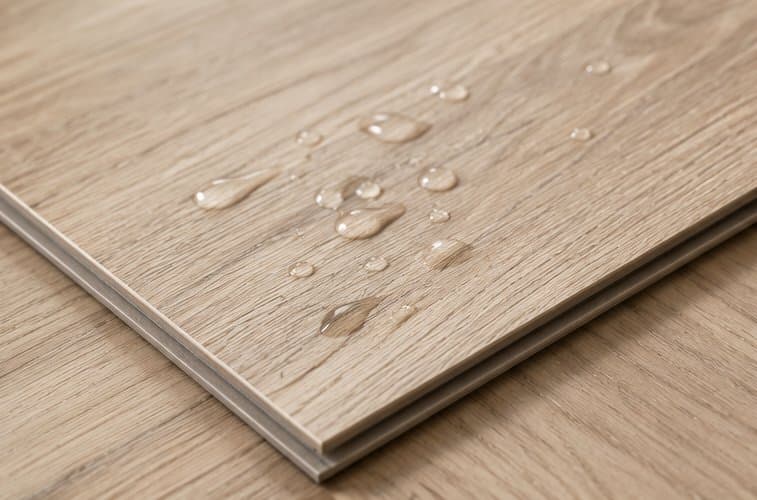
Keep it light even on a "waterproof" floor. Waterproof means the planks won't swell from a spill on top. It doesn't mean water can't run down the seams and sit under the floor, where it can lead to mould or a musty smell. Our post on whether vinyl plank is really waterproof explains where that line is. Laminate is the more sensitive of the two: even water-resistant laminate has a wood-fibre core, so standing water is never a good idea.
What never to use on vinyl plank and laminate floors
These are the things most vinyl and laminate flooring makers warn against:
- Steam mops. Heat and steam are forced into the seams and the locking edges, and can soften vinyl or swell a laminate core. Many manufacturers say using one can void the warranty.
- Soaking wet mops and buckets of water, for the same reason: the water ends up in the seams, not on the floor.
- Wax, polish, oil soaps and "mop and shine" products. These floors can't be sanded or refinished, so there's no reason to add a coating. They leave a film that looks hazy, streaks, gets slippery and holds dirt, and it's hard to strip off again.
- Bleach, ammonia and strong all-purpose or degreasing cleaners, which can dull the wear layer over time.
- Abrasive powders, scouring pads and steel wool, which scratch the surface.
- Rubber- or latex-backed mats and rugs on vinyl. The backing can react with the vinyl and leave a yellow stain that doesn't come out. Look for mats labelled safe for vinyl floors.
- A vacuum with the beater bar spinning, which can scuff the finish.
Vinegar is the one people ask about most. It's a popular tip, and a weak vinegar mix won't ruin a floor in one go, but many makers advise against it because, used again and again, it can dull the finish. A cleaner made for your type of floor is the safer choice.
Rain, grit and wet boots: floor care in the Lower Mainland
From October to spring, our rain does most of the damage to floors, and it comes in on boots, umbrellas and dogs. Wet grit from sidewalks and gravel driveways gets ground into the first few metres of floor inside the door. A good mat outside, a vinyl-safe mat inside, and a tray for wet boots and umbrellas stop most of it before it reaches the floor. Dry the dog at the door, too: puddles of rainwater along a laminate entry are exactly what its seams don't like.
Basement suites are where a lot of LVP goes in around here, and they have their own habits to watch. Keep an eye on the floor around the laundry machines, the water heater and the bathroom. A slow leak under a floating floor can go unnoticed for weeks. If a plank ever feels soft, smells musty or lifts at the seams, find the water first, then deal with the floor.
How to protect LVP and laminate floors from scratches and dents
- Felt pads under every chair and table leg, replaced when they wear thin or pick up grit.
- Wide, flat furniture cups under heavy pieces like pianos, sofas and fridges, because vinyl can dent under a narrow point load.
- Lift heavy furniture and appliances into place. Never drag them.
- A chair mat under office chairs. Rolling casters wear a path in any floor.
- Keep pets' nails trimmed, and shoes off at the door.
- Blinds or curtains on big sunny windows. Strong sun can fade some floors over time, and on a floating vinyl floor the heat from a big south-facing window can make planks move.
From a customer
“I recently had my carpet replaced with laminate flooring, and I couldn’t be happier with the results! Danny did an outstanding job from start to finish. He was professional, punctual, and incredibly detail-oriented. The quality of his work is top-tier and the flooring looks absolutely beautiful. He worked efficiently, kept everything clean, and made sure everything was perfect before finishing the job. I highly recommend Danny to anyone looking for high-quality flooring installation. Thank you, Danny, for the amazing work!”
Scuffs, stains and damaged planks
Most black scuff marks come off with a soft cloth or a dry tennis ball. For something stubborn like marker or nail polish, some manufacturers allow a little rubbing alcohol on a cloth; check your floor's care guide before you try it, and test it in a closet first.
Deep scratches, a chipped edge or a plank that swelled from a leak can't be cleaned away, but on a floating floor a damaged plank can often be taken out and replaced without redoing the room. That's one of the most common floor repairs we do, and it's why it's worth keeping a box of spare planks from your install in the garage: matching the exact colour years later can be hard.
And when an older floor is past saving, new flooring installation is the last step. As a ballpark, WoodPro's labour for waterproof laminate or luxury vinyl plank is $2.50 to $3.50 per square foot, and taking out an old floating floor is $1.00 to $1.50 per square foot, before GST. Our flooring cost per square foot guide has the full breakdown.
Can you steam mop vinyl plank or laminate?
Most manufacturers say no, and some say it voids the warranty. The heat and moisture get into the seams and the locking edges. A microfibre mop that leaves the floor barely damp cleans just as well.
Can you use a Swiffer or a spray mop on LVP and laminate?
Dry dusting pads are fine any time. For wet cleaning, a refillable microfibre spray mop with a cleaner made for vinyl or laminate works well. Disposable wet pads and all-purpose solutions can leave a film on some floors, so if your floor starts to look streaky, switch back to a pH-neutral cleaner and plain microfibre.
Why does my laminate floor look streaky or cloudy?
Usually it's leftover product: too much cleaner, a cleaner that isn't made for laminate, or an old polish building up. Mop with clean, barely damp microfibre and a small amount of the right cleaner, and buff dry with a second pad. Skip anything that promises a shine.
Is vinyl tile cleaned the same way?
Yes. Vinyl tile gets the same care as vinyl plank: dry clean often, damp-mop with a pH-neutral cleaner, no steam and no wax. For real wood, the rules change a little; see our guide on how to clean hardwood floors.
Ready for a floor that's easy to look after?
If your floor is worn, scratched or past cleaning, Danny can come out for a free on-site measure, look at what you have, and tell you plainly whether a repair will do or a new floor makes more sense. Call (604) 787-5557 to book, or browse finished floors in Our Work. We work across the Lower Mainland and Fraser Valley: Maple Ridge, Pitt Meadows, Mission, Langley, Surrey, Coquitlam, Port Coquitlam, Port Moody, Burnaby and New Westminster.