Published
Can you put new flooring over old flooring? Often, yes. Rigid-core vinyl plank and laminate float over many existing hard floors, including ceramic tile, and skipping the tear-out saves time, dust and money. But not every old floor makes a good base, and the wrong one shows up later as hollow spots, bouncing planks or a door that no longer clears. Here's how we decide, across the Lower Mainland, whether the old floor stays or goes.
This is general guidance. The flooring manufacturer's installation instructions always have the final say, and they differ from product to product, so the answer for your home comes from the free on-site measure.
Which new floors can go over an old floor?
Floating floors are the ones that can. A floating floor clicks together and rests on the surface below without being glued or nailed to it, so the old floor only has to be solid, flat and dry. That covers luxury vinyl plank with a rigid core and waterproof laminate, and many floating engineered floors too. Glue-down and nail-down floors are different: they need a clean, sound subfloor to bond or fasten to, so the old layer usually comes out or gets a new surface first.
Can you put vinyl plank over tile?
Vinyl plank over tile is the most common version of this question, and the answer is usually yes, with three conditions. Most manufacturers allow a rigid-core floating floor over ceramic or porcelain tile when:
- Every tile is firmly bonded. Tap them: a hollow sound or a cracked tile means it's loose underneath, and loose tiles have to be fixed or removed first.
- The tile is flat. Floating floors are sensitive to dips and lips between tiles; many products set a flatness limit of around 3/16 of an inch over 10 feet.
- The grout lines are filled. Wide or deep grout joints can slowly print through a thinner vinyl plank, so they're filled with a patching compound and left flush before the new floor goes down.
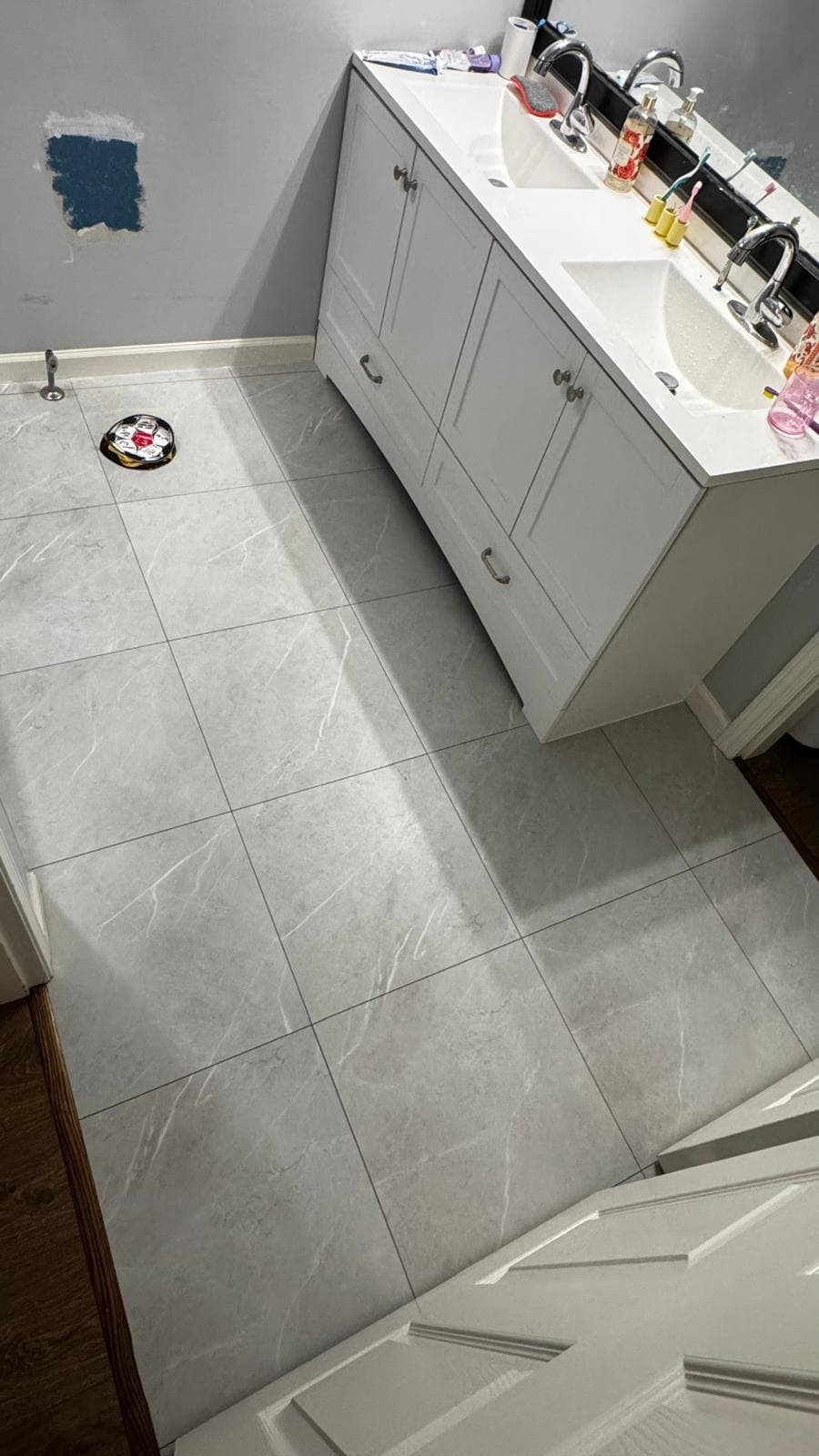
The same goes for laminate over tile. When those three conditions are met, covering the tile is often the sensible choice. Removing ceramic tile is heavy, noisy work, and the thinset underneath usually has to be ground off as well.
Laying flooring over lino or sheet vinyl
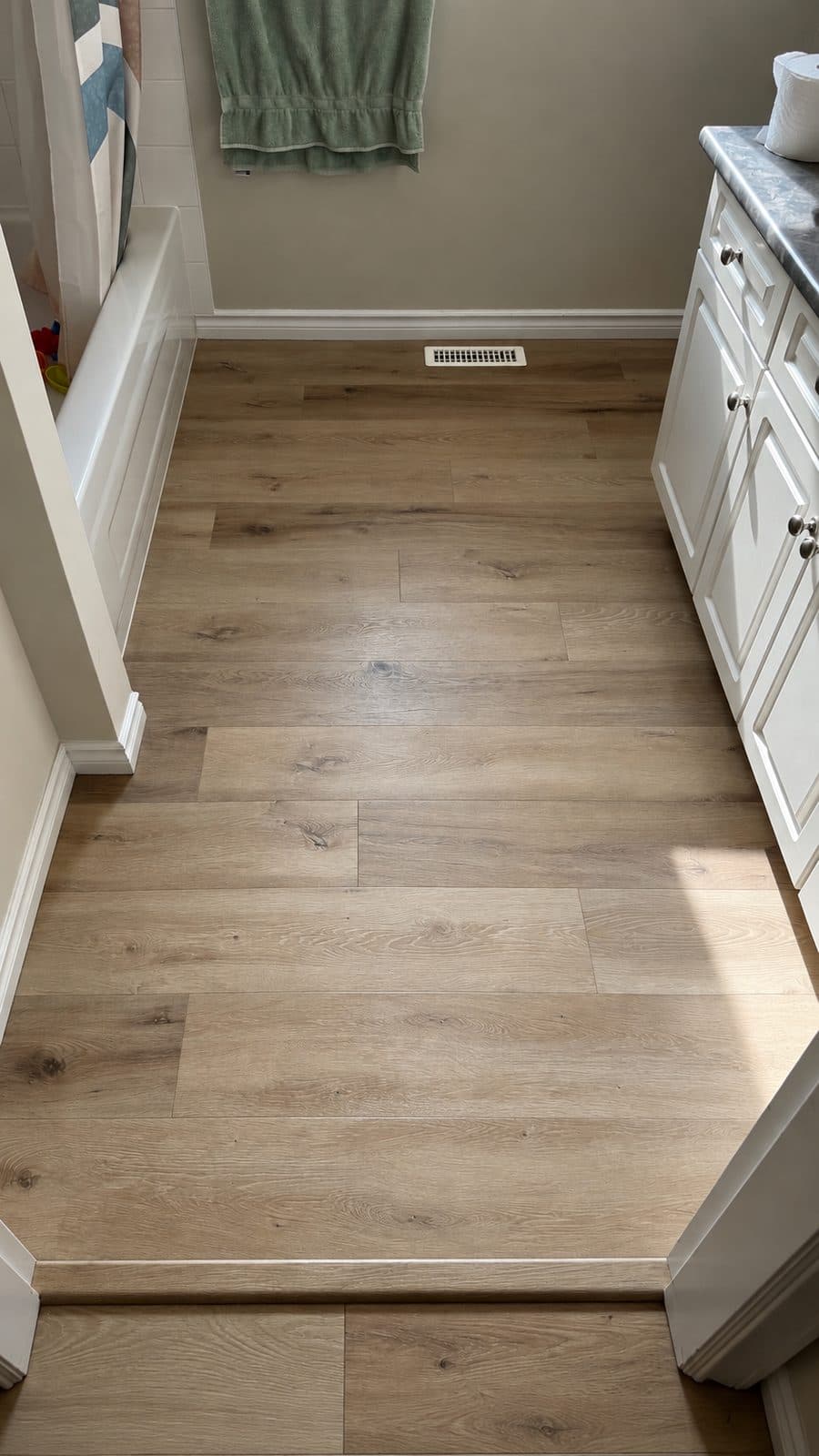
A single layer of thin, well-stuck lino or sheet vinyl is usually a fine base for a floating floor. Cushioned sheet vinyl is a different story: it's soft, and the new planks can flex on it and wear at the joints. Several layers stacked up are a problem too.
That's a real situation in older parts of the Lower Mainland. In Coquitlam, kitchens in Maillardville, Austin Heights and Coquitlam West often have two or three floors stacked up, and in New Westminster carpet over lino over the original floor is routine. Sheet vinyl, vinyl floor tiles and their adhesives from before about 1990 can contain asbestos. If an old layer is staying, covering it disturbs nothing. If it has to come out, it gets sampled and lab-tested first, and a licensed abatement contractor removes it if the test is positive.
Can new flooring go over hardwood?
Yes, if the hardwood is sound. A floating vinyl plank or laminate floor can go over a solid or engineered hardwood floor that's firmly fastened, flat and not cupped or soft from old water damage. Worth asking first, though: if the hardwood underneath is in decent shape, sanding and refinishing it might give you the floor you want without covering it at all.
Never over carpet
Carpet and underpad are far too soft to support a hard floor. The click joints flex every time someone steps on them and break within months. Carpet always comes out, along with the underpad, the tack strips and every staple in the subfloor.
What can go wrong when you skip the tear-out
Even when the old floor is a good base, the extra height has to fit the house. A rigid-core vinyl plank adds only a few millimetres, laminate a bit more. That sounds like nothing, until it's:
- A dishwasher that can no longer slide out from under the counter.
- A door that drags, especially an exterior or bathroom door with little gap underneath.
- A toilet flange that ends up below the new floor and needs an extension to seal properly.
- A trip edge where the new floor meets a room that isn't changing, which needs a reducer or transition strip.
- The top or bottom stair step ending up a different height from the rest, which catches toes. If the stairs are being redone too, our custom stairs work plans the heights together.
- Baseboards that sit too low once the floor rises. They can come off and go back on, or new ones can go in, see baseboards.
Moisture matters too. On a concrete slab, such as a basement, the floor has to be checked for moisture before anything goes over it, and a floating floor on an old floor still needs the right underlay. Our post on why levelling should never be skipped explains what happens when an uneven base is covered up.
When the old floor should come out
- Loose, cracked or hollow-sounding tiles, or a bouncy or soft floor.
- Two or more old layers already stacked up.
- Any carpet.
- Water damage, mould or a musty smell underneath.
- A glue-down or nail-down floor going in.
- Height that won't work with doors, appliances, stairs or the next room.
Taking the old floor out also shows what the subfloor is really like, which is worth knowing before a new floor goes on top for the next twenty years.
What removal costs, if the old floor goes
If the old floor has to come out, here's WoodPro's removal pricing per square foot, before GST, as a ballpark:
- Carpet, with underpad, tack strips and every staple: $1.00 to $1.25
- Floating laminate or vinyl plank: $1.00 to $1.50
- Nail-down hardwood: $4 to $6
- Glued-down hardwood or engineered: $4 to $8
- Ceramic or porcelain tile: $4 to $8
- Glued-down lino or sheet vinyl: priced at the measure
For a 100 sq ft bathroom, taking out ceramic tile works out to about $400 to $800 before GST, on top of the new floor. Any levelling is priced once the old floor is off and the subfloor has been checked. For the cost of the new floor itself, see our flooring cost per square foot guide.
From a customer
“Danny is an excellent tradesman and wonderful human being. He and his crew transformed our basement floor and stairs into a beautiful living area, replacing old tile and carpets with luxury vinyl planks and plush carpeting. He is prompt and communicative, offers valuable advice, and leaves the place spotless. His price is reasonable and the quality of his work is excellent. We’ll definitely hire him again for future projects. Very highly recommended!”
Can you put vinyl plank over ceramic tile in a bathroom?
Usually, if the tile is solid, flat and the grout lines are filled. Watch the toilet flange and the door, since both are affected by the extra height. Vinyl plank is waterproof, which suits a bathroom; for a stone look, vinyl tile is another option.
Is it cheaper to install flooring over tile?
Usually, since you save the $4 to $8 per square foot that tile removal costs. Filling grout lines and fixing any loose tiles takes some time back, but leaving sound tile in place is almost always the cheaper route.
How many layers of flooring can you have?
There's no single rule, but one old hard layer under a new floating floor is the practical limit. More than that adds height, hides problems, and makes the next renovation harder.
Find out if your old floor can stay
Danny comes out for a free on-site measure, checks the old floor and the clearances around doors and appliances, and tells you plainly whether the old floor can stay. Call (604) 787-5557 to book, or see our flooring installation page for what's included. We work across the Lower Mainland and Fraser Valley: Maple Ridge, Pitt Meadows, Mission, Langley, Surrey, Coquitlam, Port Coquitlam, Port Moody, Burnaby and New Westminster.